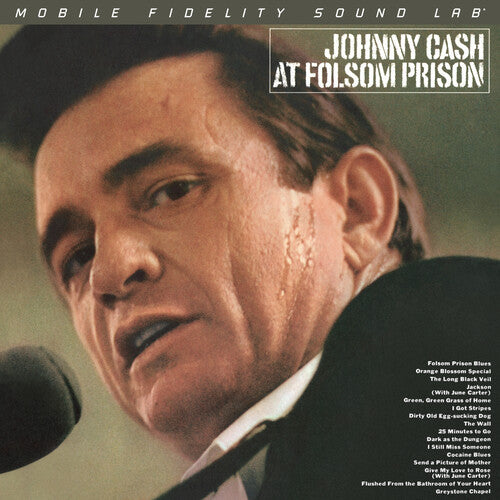
Cash, Johnny - At Folsom Prison (Mobile Fidelity, Numbered Vinyl, 180 Gram, 45RPM, 2LP)
Cash, Johnny - At Folsom Prison (Mobile Fidelity, Numbered Vinyl, 180 Gram, 45RPM, 2LP)
Format: Vinyl LP
UPC: 196588719011
Release Date: 11/19/13
Condition: N
Low stock: 1 left
Couldn't load pickup availability
Share
The 1968 Album on Which Johnny Cash Became a Legend: At Folsom Prison Among the Most Important and Potent Statements of the 20th Century
Mastered on MoFi’s Mastering System: Mobile Fidelity's Numbered-Edition 180g 45RPM 2LP Set Plays with Arresting Immediacy, Spaciousness, and Directness
1/4” / 15 IPS analog copy to DSD 256 to analog console to lathe
Johnny Cash already knew his way around Folsom Prison when he and his band stepped inside the institution’s forbidding walls on the morning of January 13, 1968 to record At Folsom Prison. He’d played there two years prior. But this time was different.
Cash took the stage that day for two shows amid a darkening sociopolitical atmosphere and a raging war in Vietnam, as well as the knowledge his career and health hung on by a thread. The Arkansas native shared many of the long odds and abject failures of the inmates for which he performed. The songs he chose, and the conviction with which he delivered them, say as much. The point at which Cash transformed from a country star into a legendary artist, and a bold statement about the American prison state and its commitment to rehabilitation, the triple-platinum At Folsom Prison remains one the most important, potent, and fabled records of the 20th century.
Mastered on MoFi’s renowned mastering system at its California studio and housed in a Stoughton gatefold jacket, Mobile Fidelity’s numbered-edition 180g 45RPM 2LP set of At Folsom Prison veritably places you in the cafeteria with the hootin’ and hollerin’ prisoners with which Cash felt a mutual chemistry, sympathy, and spirit. A through-line to the no-frills rawness that helps make this landmark record among the most genuine documents ever committed to tape, this audiophile reissue presents what transpired that winter day with a fullness, directness, spaciousness, and dynamic absent prior editions.
You can hear it echo off the walls of the room; pulse through the Tennessee Three’s itchy, acoustic-based boom-chick rhythms; crackle in the announcements conveyed over the intercom; ring in the comedy of the off-cuff remarks and pair of novelty tunes; sense it in palpable energy that wells up within Cash and his audience. And you can experience it like never before via Cash’s knockout singing. The bedrock foundation of all his music, the singer’s baritone resonates with profound degrees of depth, pliability, and passion that underscore how much this appearance meant to him — and the extent he was living the narratives.
Indeed, every song on At Folsom Prison serves a purpose and speaks to the conditions — mental, emotional, physical, geographical, legal, social — the inmates confronted on a daily basis. Beginning with the explicit messages of the opening “Folsom Prison Blues,” Cash makes it clear he understands and shares many of their plights. Not for nothing did the myth of Cash having done hard time persist for decades once this record hit the streets. That’s how real it is, and how dedicated Cash remains to conveying every note with the same truth he invests in the impromptu comments he makes between and amid songs.
Listen to the sorrow, regret, pity, and loneliness of Merle Travis’ “Dark as the Dungeon,” Cash pulling syllables til they threaten to break and inhabiting the mood of bleak phrases such as “pleasures are few” and “the sun never shines.” Witness the isolation, dejection, and sadness punctuating the walking-blues “I Still Miss Someone,” matched in gravity by a solemn reading of “The Long Black Veil” — a traditional dirge that involves murder, cheating, and deception. Cash cuts even deeper on a heartbreaking solo rendition of “Send a Picture of Mother” and plainspoken version of Harlan Howard’s “The Wall,” detailing a suicide disguised as jailbreak through cliched-jaw deliveries that softly curse the impossible situation.
In chronicling temptations, mistakes, mortality, punishment, and life “inside” — for better or worse, the stories of the disenfranchised, forgotten, written-off, and unrepentant — At Folsom Prison also has a blast playing the outlaw role. Cash captures wild-eyed craziness and out-of-control mayhem on a revved-up take of “Cocaine Blues,” taking extra satisfaction in its dastardly tales by way of voice that shifts into character for the sheriff and judge. The gallows humor and racing drama of “25 Minutes to Go”; quicksilver accents and resigned acceptance of “I Got Stripes”; train-whistle blare and twangy locomotion of “Folsom Prison Blues” — all fight the law only to see the law win.
Cash remains deeply committed at every moment, and inseparably connected with the tortured souls removed from the goings-on of the outside world. No wonder all but two songs here stem from the day’s first performance that saw Cash, Luther Perkins, Marshall Grant, and company give everything. As does the Man in Black’s soon-to-be-wife, June Carter. The couple’s fiery duet on “Jackson” scorches; their combination of surrender and fortitude “Give My Love to Rose” puts us in the dying protagonist’s shoes.
And with the closing “Greystone Chapel,” famously penned by convict Glen Sherley, who watched it all happen under the watchful eye of guards, Cash separates the corporeal from the spiritual, relaying lessons about salvation and survival. Heady themes to which he’d return for the remainder of his illustrious career.
SHIPPING & RETURNS
SHIPPING & RETURNS
FREE SHIPPING on purchases over $75 (domestic orders, media only)
LOCAL PICKUP available at checkout
$5 MEDIA MAIL shipping in the USA
RETURNS
Items may be returned within 90 days of the delivery date.
If not defective, any product returned must be in the same condition in which customer received it and in the original retail packaging.
Yellow Racket will be responsible for cost of return on all damaged or defective items. Customer is responsible for cost of return if item is not damaged or defective. Photo/video evidence of damages/defects must be provided by customer within 14 days of the delivery date.
Customer assumes all responsibility for duties and taxes associated with international shipments.
GRADING
GRADING
Yellow Racket assigns condition based on the Goldmine Standard for grading records.
New (N) (Not typically included in the Goldmine Standard)
New records are purchased directly from the label, distributor, or registered wholesaler. Records are still sealed. Jackets may have slight shelf wear, but media has never been played.
Mint (M)
Still sealed. Never played. No observable flaws. Items have been purchased secondhand.
Near Mint (NM)
A Near Mint (NM) record will play perfectly, with no imperfections during playback. The record should show no obvious signs of wear.
The cover (and any additional packaging) has no creases, folds, seam splits, cut-out holes, or other noticeable defects.
Very Good Plus (VG+)
A Very Good Plus (VG+) record will show some signs that it was played and otherwise handled by a previous owner who took good care of it.
Defects should be more of a cosmetic nature, not affecting the actual playback as a whole. Record surfaces may show some signs of wear and may have slight scuffs or very light scratches.
The disc and LP cover may have slight signs of wear, and may be gently marred by spindle marks, paper scuffs, wrinkled corners, etc.
Very Good (VG)
Many of the defects found in a VG+ record will be more pronounced in a VG disc. Surface noise will be evident, but will not overpower the music. Disc may have light scratches (deep enough to feel with a fingernail) that will affect the sound.
Labels, jackets, and inserts will have visible cosmetic flaws such as wrinkles, cut-outs, slight splitting, etc. However, it will usually have less than a dozen minor flaws.
Good (G)
A record in Good condition can be played through without skipping. But it will have significant surface noise, scratches, and visible groove wear. A cover or sleeve will have seam splits, especially at the bottom or on the spine. Tape, writing, ring wear, or other defects will be present.
While the record will be playable without skipping, noticeable surface noise and "ticks" will almost certainly accompany the playback.
Poor (P), Fair (F)
The record may be cracked, badly warped, or won't play through without skipping or repeating. The picture sleeve may be water damaged, split, or heavily marred by wear and writing.